
PRECISION LASER
REPAIR
Don't let broken laser welding or cleaning machines halt your production line.
We offer fast, reliable repair services for Raycus, IPG, Max, JPT, and Reci laser sources.
We also specialize in repairing handheld welding and cleaning heads to get your operations back on track.
Our Core Services:
Fiber Optic Cable Splicing
Precise fusion splicing for damaged fiber optical cables on welding, cleaning and cutting systems.
Handheld Head Repair
Complete rebuilding and calibration of hand-weld and laser cleaning heads.
Laser Source Troubleshooting
Fast diagnostic and repair for faulty fiber laser source.


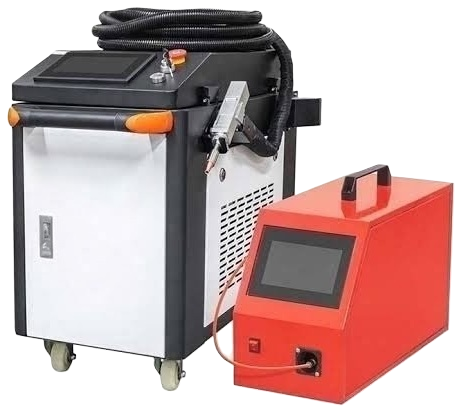


Fiber Laser Source- What's Inside?
A fiber laser source is a solid-state laser system constructed by fusing together fiber-coupled optical components, eliminating the need for mirrors and free-space optics. This specialized configuration relies on four core internal components:
- Laser Diodes - Pump Source
These are semiconductor modules that convert electrical current into high-brightness pump light.
- Pump Laser Combiner
Because a single laser diode cannot provide enough energy for high-power systems, a pump combiner is used to merge the light from multiple individual diode fibers into a single active optical fiber.
- Amplification Medium - Active Gain Fiber
This is the heart of the system. It consists of a silica glass fiber core wrapped in cladding.
- Fiber Bragg Gratings - Resonant Cavity
Instead of traditional glass mirrors, fiber lasers utilize Fiber Bragg Gratings (FBGs) etched directly into the passive fiber at both ends of the active fiber. One grating acts as a total reflector, and the other acts as a partial reflector (output coupler), trapping and bouncing photons back and forth to amplify the beam.
